- Home
- Machine Quilting 101
- Domestic Sewing Machine
Use Your Domestic Sewing Machine for Quilting
Beginning Machine Quilting 101 continues...
This post contains affiliate links for which I receive compensation.
IMPORTANT: Locate your domestic sewing machine's instruction manual and then...
...keep it handy for easy reference. You'll need it for troubleshooting, instructions on how to use accessories, install feet and small maintenance jobs. It's the place to start when a problem arises!
A Clean Machine is a Happy Machine
Your domestic machine should be clean and lubricated.
Regularly.
No excuses.
Oil according to your instruction manual
Check your instruction manual before using any oil.
Some domestic machines, and particularly the newer computerized ones, are made with parts that are impregnated with oil.
If this is the case, any machine lubrication will be done by your sewing machine dealer at the machine's annual “well baby” check up. Most manufacturers recommend a checkup once a year for your sewing machine. It will be cleaned, lubricated and the timing will be checked.
If you have an older or mechanical model, the manual tells you if, when, how and with what kind of oil to lubricate your sewing machine.
Lint robs your machine of lubrication
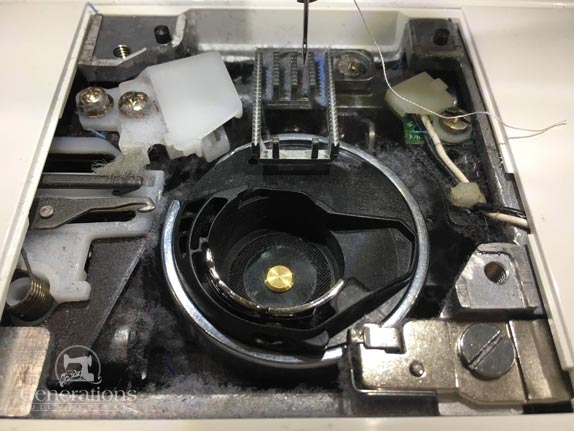
As you quilt, remember to brush out your bobbin case after every bobbin or two. After you see all the lint that builds up, you'll know why.
Be sure to check the space surrounding your feed dogs. There is not supposed to be a felt pad there. If there is, it's lint. Get rid of it!
When you change needle thread, clip it close
to the spool and then pull the tail all the way through your domestic sewing machine and
out the needle eye.
This keeps lint from being pulled back up into the sewing machine.
Why the fuss about cleaning and maintenance?
When we use our domestic sewing machine for quilting it runs pretty near constantly. It’s not like piecing where we sew a little, press a little, and trim a little.
When we are in the quilting “zone”, the pedal will be to the metal for the entire bobbin. The bobbin runs out, we quick wind another and off to quilting again.
A clean and well maintained sewing machine produces better stitches and has fewer problems during quilting, thus saving us time and frustration.
Don't blow. Suck!
If you have a serger, you might have a can of canned air around for spraying it out to clean away the link.
DO NOT use this on your sewing machine.
Not ever.
If you compare the innards of your serger and sewing machine you'll see that the serger is open with no hiding places. Your machine is a different animal.
There's all sorts of crevices to push the lint back into. We don't want that, because we know that lint robs a machine of its lubrication.
Another—and just as important—reason is the canned air can create some condensation in your machine. Without adequate ventilation, it can eventually rust out parts.
Who needs that kind of problem?
Especially when it is so easily avoided.
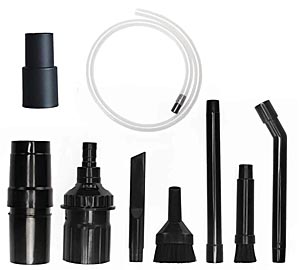
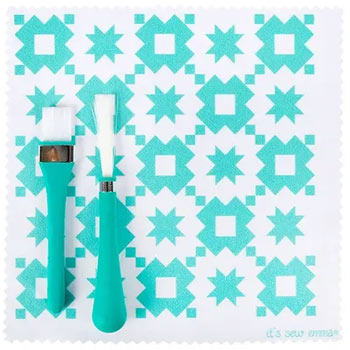
I use my machine brush and a small vacuum attachment (shown above) to keep my machine clean.
A walking foot and a darning foot are a must!
In order to quilt, you need a walking foot for straight line and “in-the-ditch” quilting and a free motion or darning foot for free motion quilting. I highly suggest purchasing these feet from your dealer instead of purchasing a generic version.
Those from your dealer are specifically engineered for your domestic sewing machine model.
Read the instructions to understand how to install both types of feet.
Problems with installation? Take both your machine and the foot/feet to your dealer for help.
Drop those Feed Dogs
You must be able to disengage the feed dogs either by dropping them or, for older model machines, by covering them for free motion quilting.
Consult your manual if you're not sure how to do it.
Visit Your Dealer
Do keep up with the latest feet offered by your sewing machine dealer.
My manufacturer added an open toe walking foot, as well as an offset “big foot” and darning foot for my domestic sewing machine. These are big improvements over the original offerings because it’s now easier to see where you’re going.
These changes were made in response to input from quilters like you and me.
So make sure to let your dealer know about the things you like about your machine and the changes that would improve it.
One final tidbit to keep in mind while you are quilting...if your machine seems to be getting too hot...like you could fry an egg on it...take a break…you probably need one too!
Table of Contents
for Beginning Machine Quilting 101
Introduction
Beginning Quilting 101: Quilting Instructions for the Beginner
Preparing to Quilt
The Quilt Sandwich
And finally, the Quilting!


The best book for the beginning machine quilter
If you can only have one in your library...this is it!

by Harriet Hargrave








Nifty Notions

By Julie Baird
Copyright © 2008-2024 Generation Quilt Patterns, LLC
All Rights Reserved
Generations-quilt-patterns.com does not sell any personal information. (See Privacy Policy)