- Home
- Quilt Binding
- Bias Quilt Binding
The Bias Quilt Binding Debate
This post contains affiliate links for which I receive compensation.
Quilters differ on whether or not to use bias quilt binding. You have several alternatives, let's see what they are.
Three grain lines for binding
There are three ways to cut strips for binding quilts; all with their own strengths and weaknesses. Each can be used for either single or double fold bindings.
True bias binding
This binding is cut at a 45 degree angle to the selvedge. True bias is very stretchy and can be used on any edge. For tightly curved edges, you must use bias to get a nice flat binding that doesn't cup.
Bias binding takes the most fabric to make.
Many fabrics, like plaids and stripes, look especially nice when cut on the bias.
Take care not to pull and stretch it out of shape when sewing it to your quilt.
Click here to learn how to make bias quilt binding.
Cross grain binding
This binding is cut in strips that are perpendicular (90 degrees) to the selvedge and makes the most economical use of fabric. In production, fabric is pulled slightly off grain as it is rolled on a cardboard bolt. So strips cut selvedge to selvedge are rarely straight on grain.
This means they have some stretch and can be used on quilts with either straight edges, mitered corners and or gently curving edges.
Bias binding is needed for tighter curves so that the binding lays flat.
Lengthwise binding
Lengthwise binding is cut on the lengthwise grain (parallel to the selvedge) of your fabric. It has the least amount of stretch of the three types.
Since this binding is so stable, it can be a good choice for quilts with bias outside edges. The lengthwise grain can stabilize those edges.
Because of its lack of stretch, use it only on quilts with straight edges. It will not lay flat for quilts with curved edges.
So what's there to debate about bias binding?
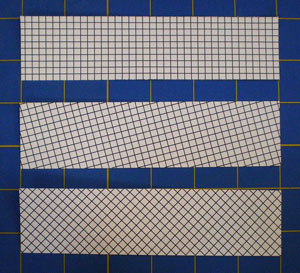 Thread coverage at the edge of bias quilt binding lengthwise grain (top), least thread coverage crosswise, slightly off grain (middle), true bias (bottom), most thread coverage
Some quilters reason that bias double fold (also called French-fold) binding is stronger because there is more thread coverage at the outside edge of the binding.
Binding cut on the straight of grain has only one long thread on the edge and is weak.
The illustration to the right shows the thread count in binding strips of equal length.
Count the threads yourself.
You will find that binding made from true bias has the most thread coverage at the edge.
Straight grain binding has the least, and cross grain binding (because it is rarely rolled onto a bolt straight on grain) is somewhere in the middle.
What's a Quilter to Do?
Determine how the finished quilt will be used.
For the majority of quilts--the ones getting moderate use--crosswise binding provides plenty of thread coverage.
For quilts that will be used and washed a lot, the extra threads in bias quilt binding is an advantage. Baby quilts (that will actually be used) and place mats definitely fall in this category. Flannel quilts and lap quilts are good candidates, too. For bed quilts, it really depends on the owner.
Binding it Up!
Whether you use cross grain, lengthwise grain or bias quilt binding, just remember to take into account:
- The pattern created on the binding due to the direction of the cut
- Whether or not the edges will be curved and how tightly
- What type of use the quilt will ultimately receive
Make your binding choices accordingly.


By Julie Baird
Copyright © 2008-2024 Generation Quilt Patterns, LLC
All Rights Reserved
Generations-quilt-patterns.com does not sell any personal information. (See Privacy Policy)