- Home
- Beginner Quilt Blocks
- Half Square Triangles
How to Make
Individual Half Square Triangles
Technique #2 - Creating a HST plus a bonus unit
This post contains affiliate links for which I receive compensation
Half square triangles are one of the standard units for patchwork piecing.
Quilting books also refer to them as a triangle squares or abbreviate it as 'HST'.
This unit is a square made from two equal right triangles.
The diagonal seam through the middle is on the bias while the outside edges are all of the straight of grain for stability.
In this lesson you'll learn how to make individual half square triangles, plus a bonus to use in another scrappy project.
Let's get to it.
Create a Half Square Triangle Plus...
a Bonus Unit from Squares
For this technique, you'll sew two squares together with one seam and create a single triangle square unit.
Pros:
- Method creates a single triangle square unit
- No 'magic numbers' to remember
- No special templates, tools or triangle paper needed
- Cut from the same size strips as other patches are
- Adding a second seam creates a bonus HST to be used later
Cons:
- If you don't intend to use the 'bonus' triangle, there's a lot of waste
- Each patch is individually marked
- There are faster methods for creating multiple identical units
The Technique
The Formula
Cut two squares equal to the finished size plus 1/2" for seam allowances.
Step 1
In this example, we want a 3-1/2" finished HST unit, so we cut two squares 3-1/2" plus 1/2" or 4" x 4".
Step 2
Mark a diagonal line from corner to corner on the back of the lightest square.
This line need only be as dark as you need to see it. Take care not to 'pull' on the bias with your pencil. (I've used the Bohin Mechanical Chalk pencil in white in the picture below. This chalk pencil is my first choice for a marking tool because it produces a consistently fine line.
Step 3
Layer the two patches right sides together, aligning all the edges. Stitch on the line from corner to corner.
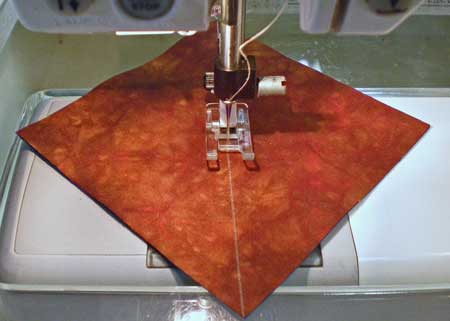
Step 4
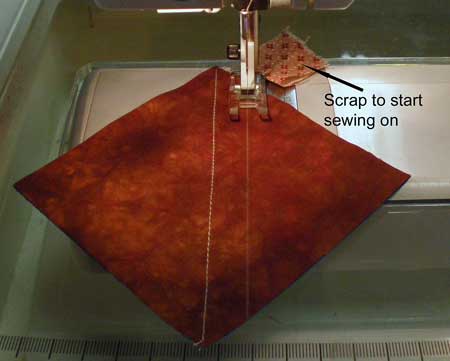
If you're a scrap quilter, then stitch a parallel line, 1/2" from the first. This creates the 'bonus' triangle with enough fabric for seam allowances for both units.
Note the scrap piece of
fabric. Sometimes your sewing machine wants to 'eat' the points of these
squares. To eliminate this problem start by sewing onto a scrap first
and then onto your squares. I call this scrap a 'spider', others call it a 'bunny tail' or anchor cloth. I'm sure there are more names...
It also helps to starch your quilt fabric before stitching.
Step 5
Press the unit flat to set the seam.
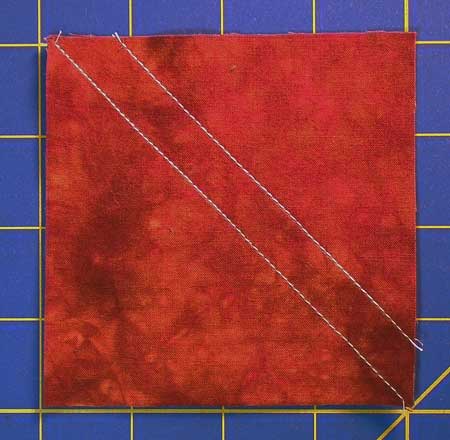
Step 6
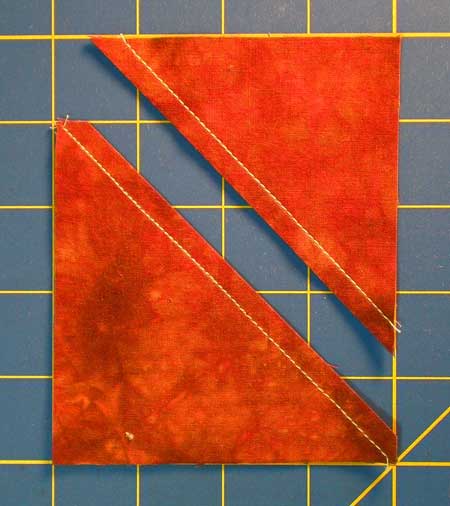
Cut the sewn squares in two between the stitching lines.
If you chose not to create a bonus unit, then trim away the excess fabric 1/4" from the stitching line on one side.
Step 7
Finger press along the seam line to minimize the chance of a tuck forming. Press flat with your iron and trim off the dog ears. The dog ears have been trimmed from the larger triangle square (below, left), but not from the smaller, bonus unit (below, right).

The final triangle unit is 4" unfinished (the same size as the cut squares because you stitched down the center diagonal) or 3-1/2" finished. The bonus unit is approximately 3-1/4".
Admittedly, at some point, the bonus triangles just get too small.
But with larger half square triangles, you end up with a nice bonus unit with little extra work. Keep them neatly stored and trim just before using in your next scrap quilt.
Itchin' to stitch?

Now that you've got two different methods for making HST's, check out our Free Quilt Block Patterns library and put your skills to good use!
What about a different quilt block?
For a list of all the 215+ quilt block patterns on this site, start here.
If you know the name of the block, shorten your search by using these links:
Click here if you're looking for blocks with at least some paper piecing.
Click here if you're looking for the basic building blocks of quilting, i.e., Flying Geese, half square triangles, quarter square triangles, etc., along with several techniques to make each.
And finally, use these links to find blocks in these finished sizes:





By Julie Baird
Copyright © 2008-2024 Generation Quilt Patterns, LLC
All Rights Reserved
Generations-quilt-patterns.com does not sell any personal information. (See Privacy Policy)