This post contains affiliate links for which I receive compensation
Free Motion Quilting Tension Problems
by Vivian
(Hingham, MA)

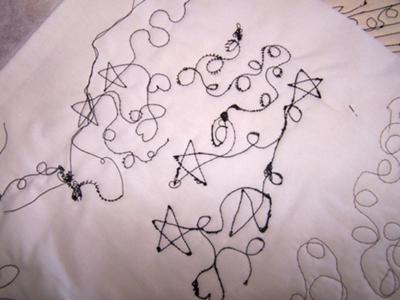
The top side...
(Click on a thumbnail image below for a larger picture.)

|

|
How do I know which tension—needle or bobbin—is out of sync? I can see the top thread on the bottom of my quilt sandwich. A trace to loops to tangled loop messes.
Reply
Thank you, Vivian, for supplying pictures of your problem. They help SO much!!!OK, let's get down to business. First, check all the basics...
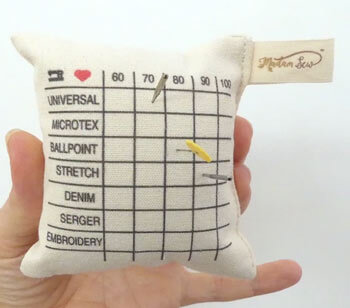
- Put in a 'new-out-of-the-package' needle. Needle points are fragile, especially the ones on the MicroTex Sharp and quilting needles simply because they are so fine. A damaged needle can through off your tension adjustments.
- Re-thread your sewing machine completely, sometimes the thread pops out of the tension disks. I don't believe it's the tension disk in your situation because then ALL the tension would be bad. You'd basically have a continuous bird's nest or 'thread throw-up' on the backside. But it doesn't hurt to double check.
- Check that you've used all the thread guides on your machine. Double check that last guide just above the needle. This one gets missed sometimes. All the guides along your thread path add a bit of tension as your thread winds it's way to making a stitch.
- Make sure that you have a nice, tightly wound bobbin that looks smooth. Once in awhile, my machine just plains winds a crappy looking bobbin. You'll be able to tell because it looks sloppy. If that's the case, I find that I can add a bit of extra tension by letting the thread run over my finger as the bobbin fills.
- Finally, make sure that you've put the presser foot in the down position. Even though you're free motion quilting with a darning foot, and the foot hops along instead of pressing down on the quilt sandwich, putting the foot down is what engages the tension disks as you sew.
Adjusting Your Needle Tension
While it is possible that a tension problem is solely attributable to your bobbin (see NOTE below), my experience is the majority of problems are solved with adjustments to your needle tension.Since your needle thread is showing (looping) on the backside, needle tension is too loose.
To tighten it, increase the number on your tension controls. If the control is a knob, just remember 'righty-tighty'. Adjust by one number at a time and test. Repeat until you're satisfied with your quilting stitches.
Tension is Wonky on Curves
Now, if you have loops on curved areas on the backside of your quilt, that is called 'eyelashing'. You'll find that the rest of your quilting stitches look pretty good, just the curves have problems.In that case, first try slowing down as you go around the curves.
Sometimes we like to 'whip around' a curve...it kind of feels natural...but slow down and try to move the quilt sandwich at an even pace, while keeping the stitching speed steady, too.
Be prepared.
It does feel un-natural to stitch this way at first. However, as you get used to moving the quilt sandwich at an even speed it becomes rather zen-like and peaceful. (OK. I don't mean to sound New-Agey, but I don't have a better description of the feeling.)
The other thing you can do for eyelashing is to 'tweak' the needle tension just a bit. You still want to keep the rest of the quilting looking nice, but you should be able to tighten it just a bit and that may do the trick.
NOTE: Now if your needle thread was pulled to the backside, but not looping, and the adjustments described above didn't correct the problem, then adjust the bobbin case tension screw.
First mark the orientation of screw before you make any adjustments. Then you'll know the position to return it too when you are finished.
To loosen the bobbin tension, you'd turn the screw an eighth of a turn to the left (remember 'lefty-loosey'). Stitch on a practice sandwich to test and keep adjusting until you are satisfied with your stitches.
Vivian, I hope I've been able to help.
Thank you for your question...AND for supplying the pictures...that helps a lot!
Piecefully,
Julie Baird
Editor
Comments for Free Motion Quilting Tension Problems
|
||
|
||
|
||
|
||
|
||
|
||
|
||
|
||
|
||
|
||










Nifty Notions



By Julie Baird
Copyright © 2008-2024 Generation Quilt Patterns, LLC
All Rights Reserved
Generations-quilt-patterns.com does not sell any personal information. (See Privacy Policy)